
the game’s easy, as these seven items confirm
Looking at a 3-player game ….
and starting from the point where a hike just ended
Cards 11-13 of the 53 card pack are removed.
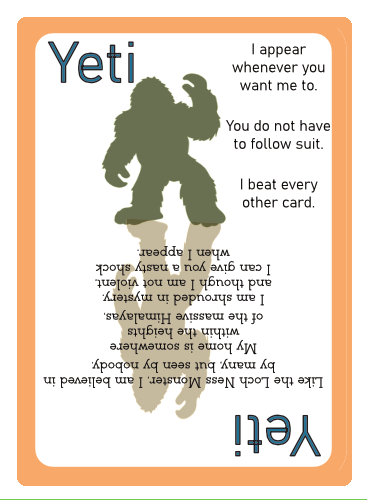
The deck is 41 cards of four suits, including the Yeti – a wild card.
1 – hike-scores on individual scorecards
Hikers each had a different goal to achieve – to act as hike-leader. The sum of the three goals is the number of available tricks: twelve.
In a 3-player game rotating goals are 6, 4, and 2. That’s three hikes within a full turn.
Tricks won are white numbers (“on black” now deleted) background. Score-counters start on zero.
Red or green numbers indicate whether the hiker was above or below their goal.
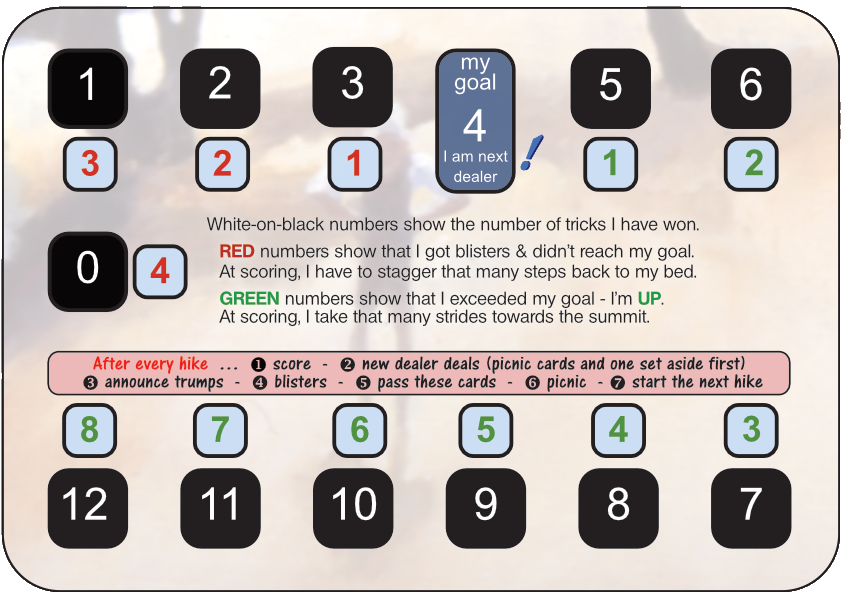
2 – scores are recorded onto the game-score board
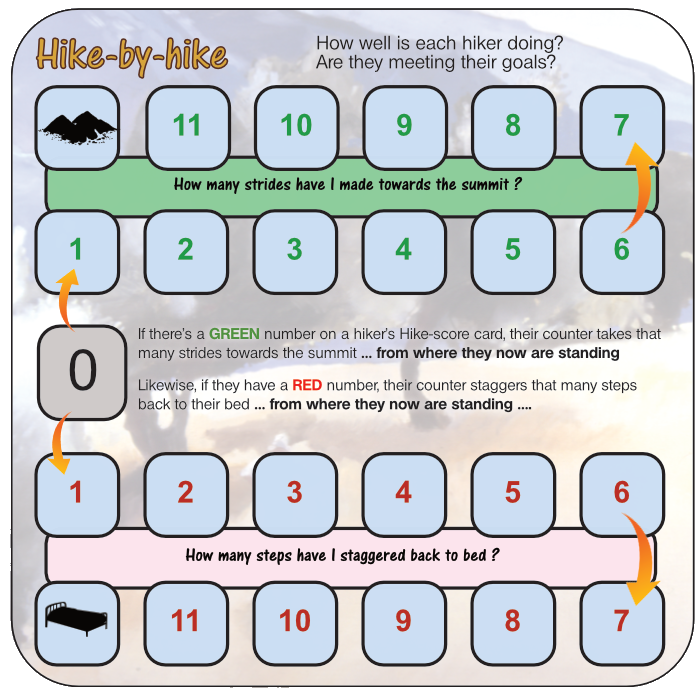
Hikers’ scores are added to what’s already on the hike-by-hike
score board.
“Added to” isn’t always understood when negative numbers appear. Mathematics is side-stepped by “taking strides” towards the summit (green score), or staggering back towards bed (red score – blistered).
The sum of scores (steps) should be zero.
Players rarely become widely separated, and positioning on the board can change relatively rapidly.
Another game-score board allows for cumulative scoring of tricks won. This is the better approach if it’s decided to play to an agreed score.
Either or both scoring boards can be used.
Individual scorecards are not yet exchanged after game scoring, and hikers’ score counters remain in place on their cards.
3 – dealership now changes – cards dealt – trumps set
The hiker who last had a goal of 4 will next have a goal of 6 – they also will become dealer (there’s a reminder on this player’s individual scorecard).
This new dealer shuffles all 41 cards, and sets one aside – it is out of play for the forthcoming hike.
Four more cards are laid close-by, face down. These are the picnic.
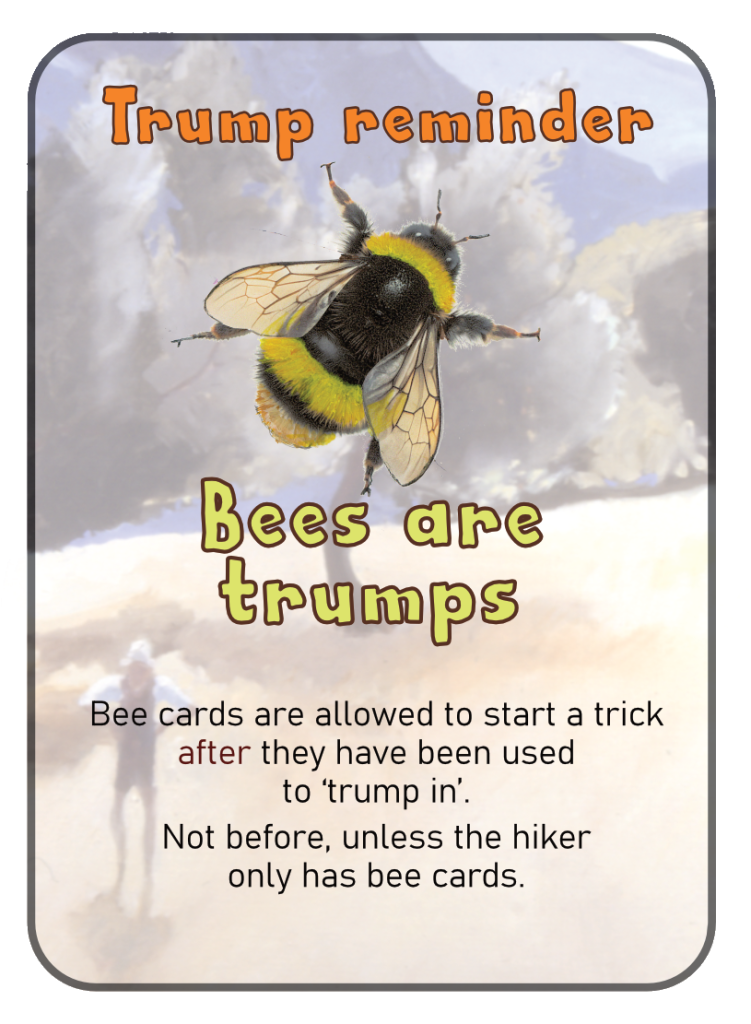
On the basis of the 12 cards in hand, dealer announces trumps and places a trump-reminder card mid table.
Trumps outrank the other three suits. They may not be led until ‘broken’.
The suits are bees, deer, crows and frogs.
Could be hiking areas, hills, National Trust properties, weather … etc
4 – now, blisters are plastered
Hikers who have red scores on the individual scorecards got blisters, which held them back from achieving their goal for the hike.
One card at a time, and going in turn (if more than one hiker is blistered), an exchange is made with hikers who are up – those having a green score on the card.
The blistered hiker passes any non-trump card face down to the “up-hiker”. The up-hiker must return (face down) their next highest card in the same suit. If they have none higher, the ‘blister’ card goes back.
This proceeds until all blisters have received plasters. It is a leveling feature that calls for careful consideration, and often leads to whoops and grimaces.
Once all exchanges are done, individual scorecards are passed left.
5 – shall we picnic?
Now the dealer chooses whether to take the four unseen picnic cards into hand.
They are not permitted to look in advance, nor to exchange less than four, nor one at a time.
6 – play then begins
Player to dealer’s left plays the first card of the first trick.
Play goes as in such games as Spades and Whist (and the solo game, For Northwood). All are based on trick taking and include trumps.
The only thing that’s different is the existence of the Yeti, which beats every other card.
(If it isn’t a card that’s out of play, that is.)
It may be played whenever its owner wishes.
They do not have to follow suit.
And thus the game proceeds.
7 – play ends
There is no defined end-point.
It can go on for as long or short as players wish.
It will cease when …
* an agreed number of rounds or hikes have been played
* an agreed time has been reached
* an agreed score has been achieved (using cumulative scoring)
* everyone falls asleep
The guidance leaflet is on A4 – printed back to back.
It’s cut to size to fit into my prototype box.
There have been further small tweaks to the guide’s wording
and to scoreboard design since this was posted.